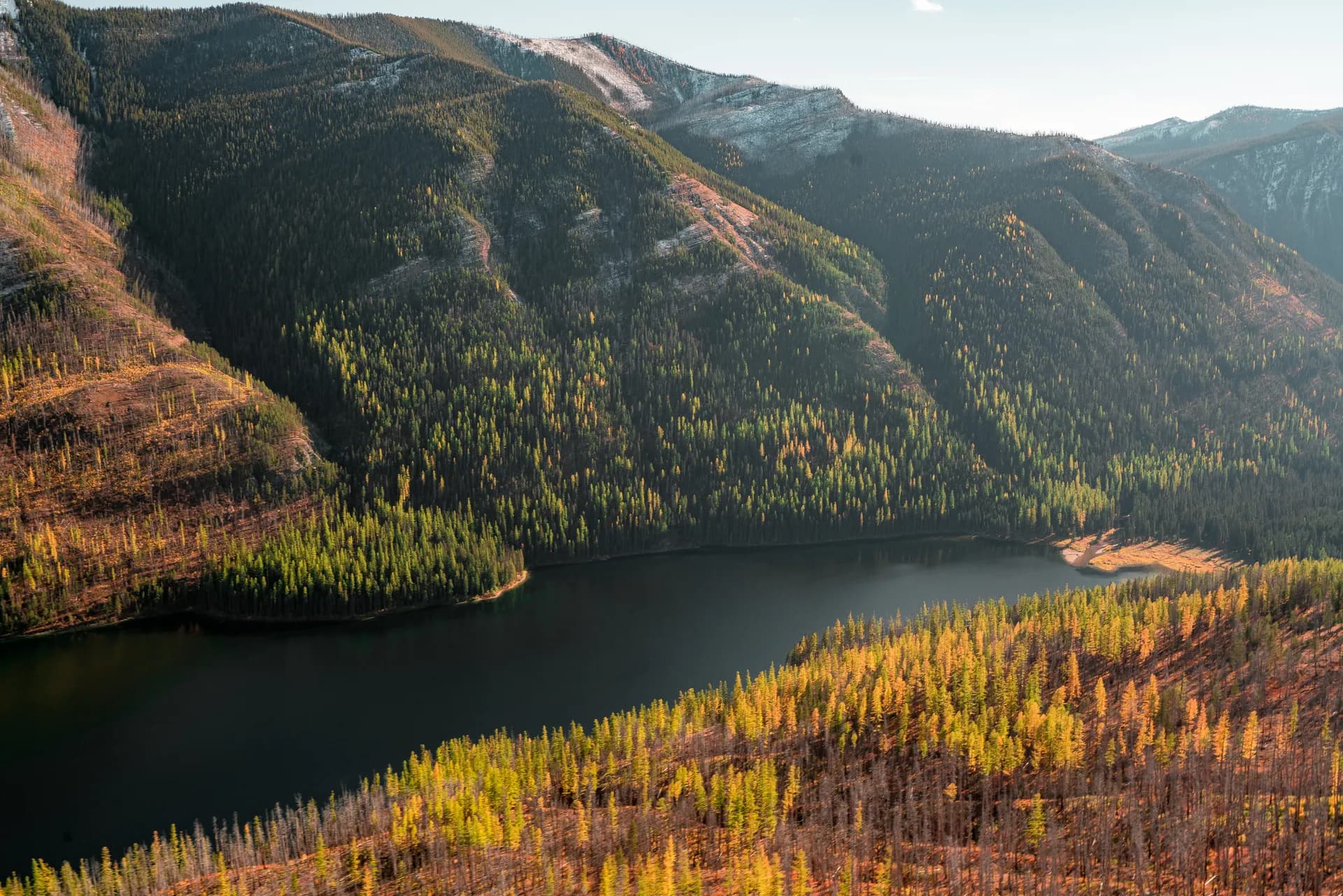
Flathead National Forest covers 2.4 million acres of northwest Montana, wrapping around Glacier National Park on three sides like a massive green buffer. It's part of the Crown of the Continent Ecosystem, one of the most intact temperate ecosystems in the world. Grizzly bears, wolves, mountain lions, wolverines, and mountain goats all live here in numbers that would have been common across the West a century ago but are now increasingly rare.
The forest was established in 1897, making it one of the oldest in the system. It stretches from the Canadian border south to the Seeley Lake area (where Holland Lake Falls is a popular day hike), and from the peaks of the Swan Range west to the shores of Flathead Lake. If Glacier National Park is the crown, Flathead is the kingdom surrounding it: wilder, emptier, and in many ways more rewarding for people willing to venture beyond the paved overlooks.
Why Flathead Stands Out
Three things set Flathead apart from most national forests in the country: its proximity to Glacier, its wilderness, and its wildlife.
Gateway to Glacier National Park. Flathead shares over 200 miles of boundary with Glacier. Many of the access roads, staging areas, and overflow campgrounds that support Glacier visitors sit on Flathead land. But beyond the logistical relationship, the two areas form a continuous wild landscape. Trails in Flathead connect directly to Glacier's backcountry (the Glacier View Mountain trail is one prime example), and the wildlife doesn't know where one ends and the other begins.
Bob Marshall Wilderness Complex. The southern portion of Flathead contains the northern section of the Bob Marshall Wilderness, along with the Great Bear Wilderness. Together with the Scapegoat Wilderness to the south, these form the Bob Marshall Wilderness Complex: over 1.5 million acres of roadless land. "The Bob," as locals call it, is one of the most remote places in the lower 48. The Chinese Wall, a 1,000-foot limestone escarpment stretching 22 miles, is the signature feature. Getting to it requires a minimum 25-mile hike or horseback ride. This is not weekend backpacking country. This is expedition territory, and it has been since long before that word became a marketing term.
Grizzly bear country. Flathead sits in the Northern Continental Divide Ecosystem, which supports one of the largest grizzly bear populations in the lower 48 (estimated at over 1,000 bears). You are not visiting grizzly country here. You are in it, every time you step off a road. This is a defining feature of the Flathead experience, not something to be afraid of, but something that demands respect and preparation.
Best Trails in Flathead National Forest
Flathead has hundreds of miles of trails, from quick day hikes near town (like the Hornet Lookout fire tower hike) to week-long wilderness traverses. These four cover a range of experiences.
Jewel Basin
The signature hike. Jewel Basin Hiking Area is a 15,349-acre area in the Swan Range dedicated exclusively to foot traffic. No bikes, horses, motorized vehicles, or dogs. It's one of the only hiking-only designations in the National Forest system. The area contains 27 named alpine lakes, 35 miles of trails, and some of the best accessible alpine scenery in Montana.
The main route (Alpine Trail #7) is an 8-mile out-and-back with 1,800 feet of elevation gain, reaching a string of crystal-clear alpine lakes set in granite basins above treeline. Strong hikers can explore further into the network, connecting trails to reach Birch Lake, Wildcat Lake, or the Black Lake area. It's one of those places that rewards extra time and curiosity.
Danny On Trail
A 3.6-mile out-and-back summit hike at Whitefish Mountain Resort, gaining 1,500 feet to the top of the ski area's summit. The trail climbs through wildflower meadows and subalpine forest to a viewpoint with panoramic views of Glacier National Park, Flathead Lake, and the Whitefish Range. It's a popular after-work hike for locals and an excellent option for visitors with a half-day to spare. Dogs are welcome on leash.
Great Northern Trail
A 6-mile out-and-back that follows the old Great Northern Railway grade through dense forest with views of the surrounding peaks. The trail gains about 2,000 feet and passes through prime grizzly bear habitat. Carry bear spray, make noise, and stay alert. This trail sees less traffic than the options closer to town, which is part of its appeal (and part of why bear awareness matters more here).
Stanton Lake
A mellow 3.6-mile out-and-back with only 400 feet of elevation gain, leading to a peaceful backcountry lake near the southern boundary of Glacier National Park. The trail winds through old-growth cedar and hemlock forest, with the lake appearing suddenly through a break in the trees. It's a good option for families, early-season hikers, or anyone wanting a quieter day. The lake itself sits beneath Stanton Mountain, and the setting feels much more remote than the short walk would suggest.
Permits and Passes
Flathead keeps it simple compared to forests in the Pacific Northwest.
No wilderness permits required. Unlike many western forests, Flathead does not require permits for day hiking or backcountry camping in the wilderness areas. You can walk into the Bob Marshall, the Great Bear, or Jewel Basin without a reservation. This is increasingly rare in the national forest system and is one of the real advantages of hiking here.
Campground fees. Developed campgrounds charge $10 to $20 per night. Some accept reservations through Recreation.gov; others are first-come, first-served. The America the Beautiful Interagency Pass does not cover campground fees.
Campfire restrictions. Fire danger is a serious concern in Montana, particularly from late July through September. The forest frequently issues campfire restrictions during dry periods. Check the Flathead National Forest website or call the Supervisor's Office in Kalispell (406-758-5204) before your trip. Violations carry significant fines.
Float permits. If you're planning to float the forks of the Flathead River (South Fork, Middle Fork, or North Fork), check current regulations. Commercial outfitters need permits, but private floaters generally do not. River conditions change annually.
Camping
Flathead offers developed campgrounds, dispersed camping, and backcountry camping in wilderness areas.
Big Creek Campground sits on the North Fork of the Flathead River near the northwest entrance to Glacier National Park. It has 22 sites, potable water, and vault toilets. Sites are $15 per night and can be reserved through Recreation.gov. The location is prime: right on the river with easy access to both Glacier and the North Fork area.
Murray Bay Campground occupies a point on the west shore of Hungry Horse Reservoir. With 25 first-come, first-served sites at $12 per night, it offers lakeside camping with boat access. The reservoir is popular for fishing (lake trout, bull trout, and kokanee salmon) and the campground rarely fills on weekdays.
Emery Bay Campground is another Hungry Horse Reservoir option, with 25 reservable sites at $18 per night. It's slightly more developed than Murray Bay, with a boat launch and better road access.
Spotted Bear Campground is the gateway to the Bob Marshall Wilderness, sitting at the end of Spotted Bear Road, 55 miles south of Hungry Horse. It has 13 sites at $10 per night, first-come, first-served. This is the staging area for backcountry trips into the Bob via the South Fork of the Flathead River. The drive in is long and partly unpaved, but the remoteness is the point.
For dispersed camping, the Flathead has extensive options along forest roads, particularly in the Hungry Horse Reservoir area and along the North Fork Road. Camp at least 200 feet from water, use existing fire rings, follow Leave No Trace principles, and observe current fire restrictions. Bears are active throughout the forest, so proper food storage (bear-resistant containers or hanging) is mandatory, not optional. Read our guide on how to get a national forest camping permit before your trip to understand the permit landscape for other western forests, even though Flathead itself requires no permit for backcountry camping.
When to Visit
Flathead has a short hiking season. This is northern Montana, and the mountains are serious.
July through September is the realistic window for most trail access. Snow lingers at higher elevations into July, and alpine trails like Jewel Basin may not be fully clear until mid-July in an average year. After a heavy-snow winter, some high routes stay snowy into August.
July and August bring the warmest weather: daytime highs in the 70s to 80s in the valleys, 50s to 60s at higher elevations. Afternoons can bring thunderstorms, especially in July. These storms build fast and hit hard. If you're above treeline, pay attention to the sky and start your descent early.
September is the best month for hiking if the weather cooperates. The crowds thin (both in the forest and in Glacier), the larch trees turn gold in the high country, the bugs are gone, and the bears are focused on eating rather than exploring. Nights get cold, dropping into the 20s and 30s, and the first snow can arrive at higher elevations by late September.
Wildfire season is a reality in Montana. Late July through September, smoke from regional fires can dramatically reduce air quality and visibility. Check Montana DEQ air quality forecasts and InciWeb for active fires before committing to a trip. Some years are fine; some years the smoke is thick enough to make outdoor activity unpleasant or unhealthy. This is not something to ignore, especially if you have respiratory sensitivities.
Winter brings heavy snow to the mountains (200 to 400 inches at higher elevations). Whitefish Mountain Resort provides world-class skiing, and cross-country skiing and snowshoeing opportunities abound. But the backcountry is serious avalanche terrain. Winter travel requires avalanche safety training and equipment.
Getting There
From Kalispell (10 minutes). Kalispell is the primary gateway. The forest begins at the edge of town. Head east on Highway 2 toward Glacier, north on Highway 93 toward Whitefish, or south on Highway 83 toward Seeley Lake to access different areas of the forest. Glacier Park International Airport (FCA) in Kalispell has daily flights from Seattle, Salt Lake City, Denver, Minneapolis, and other cities. Summer service is more frequent.
From Whitefish (10 minutes). Whitefish sits just north of Kalispell and is slightly closer to the northern sections of the forest and Whitefish Mountain Resort. The Whitefish Lake Lookout trail provides views of the lake and surrounding peaks. It's a charming small town with good restaurants, breweries, and gear shops.
From Missoula (2 hours). Take Highway 93 north through the Flathead Reservation and along the west shore of Flathead Lake. The drive is scenic, passing through the Mission Valley with views of the Mission Mountains. Missoula has a larger airport (MSO) with more flight options.
Road conditions. Many forest roads are unpaved and can be rough, particularly the roads to Spotted Bear and along the North Fork. A high-clearance vehicle is recommended for backcountry access. The North Fork Road is notorious for potholes and washboards. Check conditions with the ranger district before heading down remote forest roads.
Practical Tips
Bear safety is not optional. This is the most important piece of advice for Flathead National Forest. Carry bear spray on every hike, know how to use it (practice drawing and deploying before you need it for real), and keep it accessible on your hip or chest, not buried in your pack.
Additional bear protocols:
- Make noise on the trail, especially on blind corners and near streams where bears may not hear you coming. Clapping, talking loudly, or calling out works better than bear bells, which studies have shown are largely ineffective.
- Never hike alone if you can avoid it. Groups of three or more are statistically much safer in bear encounters.
- Store all food, trash, and scented items in bear-resistant containers or hang them from a bear pole (provided at some campsites) or a properly rigged bear hang (at least 10 feet up and 4 feet from the trunk).
- If you encounter a grizzly, do not run. Back away slowly while speaking in a calm voice. If a grizzly charges, stand your ground: many charges are bluffs. Use bear spray at 20 to 30 feet if the bear keeps coming. If contact occurs, play dead (face down, hands behind neck, legs spread to prevent being rolled). For black bears, the advice is different: fight back.
Water treatment. Giardia is present in most surface water in the Flathead area. Filter or treat all water from streams and lakes. A pump filter or UV purifier works well. Chemical treatments (iodine, chlorine dioxide) are a lightweight backup.
Ticks. From April through July, ticks are active at lower elevations, particularly in grassy areas and brushy trails. Check yourself thoroughly after every hike, paying attention to hairlines, waistbands, and behind the ears. Permethrin-treated clothing is effective prevention.
Mosquitoes. From late June through August, mosquitoes near lakes, wetlands, and river bottoms can be aggressive. Bug spray with DEET or picaridin is essential. A head net is worth carrying, especially for backcountry camping.
Cell service. Kalispell and Whitefish have reliable coverage. Once you're in the forest, expect dead zones. The North Fork area, Hungry Horse Reservoir, and the Spotted Bear corridor have no service. Download offline maps and let someone know your itinerary before heading into the backcountry.
Flathead Lake. While technically not within the national forest, Flathead Lake is worth a visit. At 28 miles long and nearly 200 square miles, it's the largest natural freshwater lake west of the Mississippi. The water is astonishingly clear (visibility exceeds 30 feet in many areas). The west shore has several state parks with public access for swimming, kayaking, and picnicking. Wild Horse Island, accessible by boat, is home to bighorn sheep and a small herd of wild horses.
Planning Your Trip
Flathead is best experienced as part of a broader northwest Montana trip. Most visitors combine it with Glacier National Park, and that makes sense. But don't treat the forest as an afterthought or a backup plan for when Glacier is crowded (though it works well for that, too). Jewel Basin alone is worth the trip. The Bob Marshall Wilderness is a once-in-a-lifetime experience for serious backpackers. And the simple act of hiking in country where grizzly bears still roam free has a weight and a wildness that most places in the lower 48 can no longer offer. If you're new to the distinction between national forest and national park designations (Glacier vs. Flathead being a prime example), our national forests vs. national parks guide is a useful starting point.
Book your campsite or lodging early for July and August. Kalispell and Whitefish have plenty of hotels, vacation rentals, and private campgrounds, but the entire region fills up during peak Glacier season. September is the smart play if you have flexibility: better weather odds, fewer people, golden larch, and bears fattening on huckleberries instead of paying attention to hikers.
Bring bear spray. Bring it even if you think you won't need it. Bring it especially if you think you won't need it.